
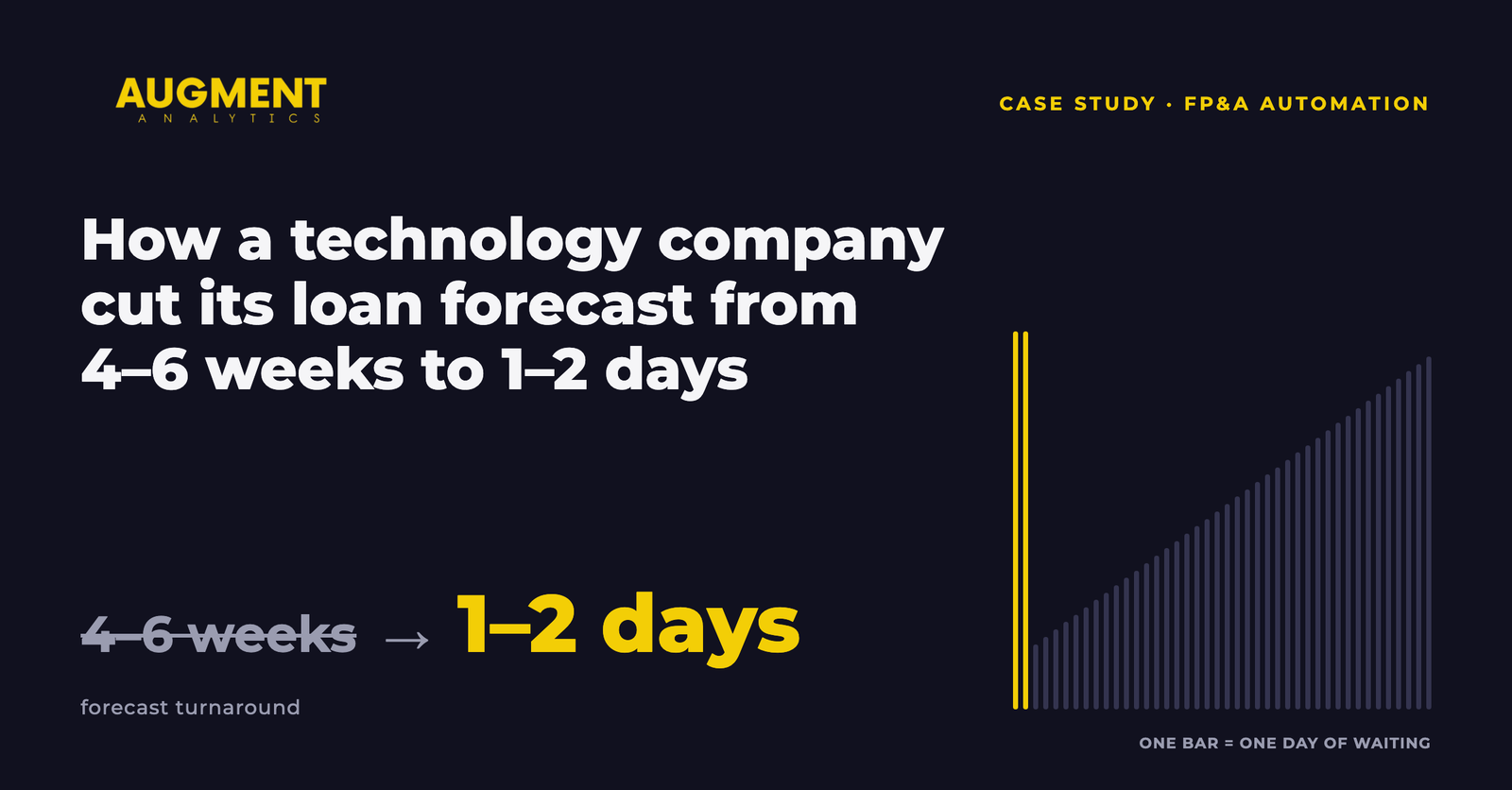
Every quarter, a consumer lending team waited 4 to 6 weeks for its portfolio forecast (new loans, balances, delinquencies and income) from an outside firm. Inside the company, the people who understood the model had left.
The team sat in a technology company’s consumer lending division. Two months into the quarter, the team sent its loan data to an outside accounting firm. The results came back four to six weeks later, after the quarter had already closed. So the team planned each new quarter from a starting point it had to estimate.
At a Glance
- Client: A technology company. The work focused on its consumer lending division.
- Function: Finance and FP&A
- Augment services: FP&A automation, loan forecasting, scenario planning, embedded finance support
- Tools: Python, GitHub
- Engagement: One Augment consultant embedded in the client’s team for about 18 months
- Consultant background: Bank regulatory stress testing (CCAR)
The Challenge
The lending business was young and had a history of stops and starts. It had no FP&A team. The people who built its forecasting processes had left. The colleague who took over inherited complex processes with no written procedures, and nobody remained to train the next person. Work the team could not finish went to the outside firm.
“They were at the whims of [the outside firm’s] deadlines, [its] turnaround times. …”
Augment FP&A consultant
That left the company with three problems.
- Slow answers. Every forecast took four to six weeks to come back. The finance team worked to someone else’s deadlines.
- Stale inputs. Forecasts used estimates because the real quarter-end values arrived too late.
- No control. The portfolio forecast lived outside the company, with the company’s corporate accounting firm. The lending team could not run its own numbers.
The Decision
Augment placed an FP&A consultant inside the team, someone who came to Augment from regulatory stress testing at banks, including CCAR work.
The consultant’s first decision was to hold off on automation. The people who built the forecast had left, and with no written procedures the team had no way to know which of the model’s assumptions still held. Automating it as it stood would only have produced the same answers faster.
So the consultant spent about three months rebuilding what the company knew about its own forecast. Every assumption in the existing process went onto a list, and each one went back to the team for confirmation. If the team agreed, the work moved ahead. If not, the assumption changed. Only then did the automation work begin.
“It was about three months of going through and saying, ‘Hey, all right, I’ve put together the list of assumptions that we’re making. Do you still agree with those?’”
Augment FP&A consultant
The first priority was expected new business and how the loan book would perform. Every other number in the forecast flowed from those two.
The Approach
Building a forecast that runs from activity to outcomes. The model moves from what the business is doing to what the outcome will be. It starts with expected new business and loan-book performance, then forecasts delinquencies, income and the financial results that follow. Average loan balances and income are projected over time from economic drivers, and all of it runs in Python.
Bringing the portfolio forecast in-house. Augment’s consultant reverse-engineered the outside firm’s process and rebuilt it as an in-house workflow, along with full model documentation showing how the testing works and what the results are. That documentation proved to corporate leadership that the lending division could run the model in-house and get the same result.
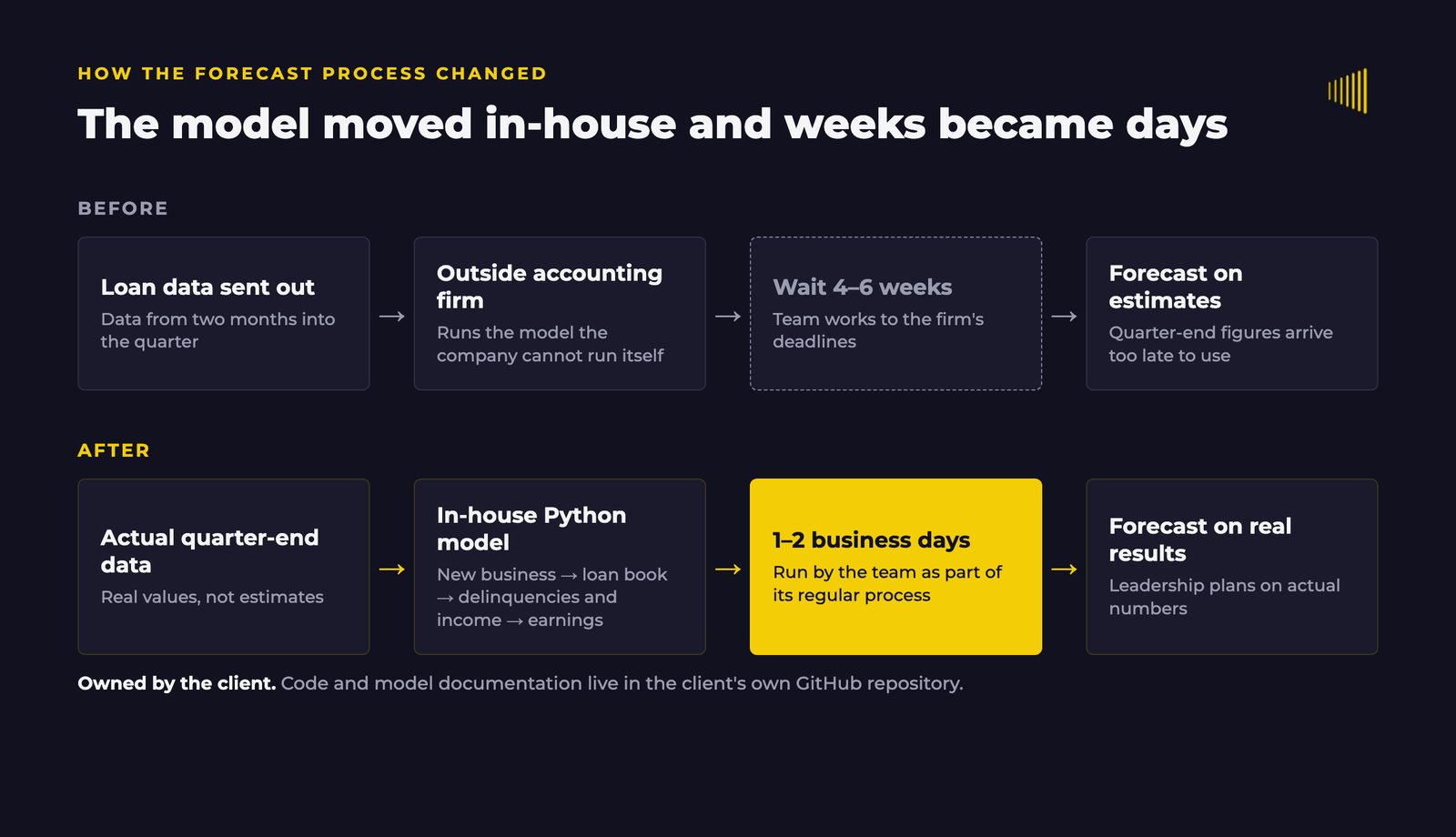
Keeping ownership with the client. The code lives in the client’s own GitHub repository. The finance team can see it and run it without outside help.
“It’s not just something where we’ve created a better system for them, but that better system exists owned by them.”
Augment FP&A consultant
Modeling the path to profitability. Because the business was young, leadership kept testing different futures, and the consultant modeled three of them: a growth track, a flat case, and a case that held flat for a period before growing. The consultant worked with the dealer sales team and the division’s director to tie what the field expected to the numbers in the model. That showed leadership what it would take for the business to become profitable. The scenarios changed as conditions changed, and this work continued through the whole engagement.
Day to day, the consultant worked with four or five people at the client as one of the team.
“They message me requests like a teammate. … It very much feels like we are all pulling the same rope in the same direction.”
Augment FP&A consultant
The Results
The forecast that once took four to six weeks now comes back in one to two business days, and the team runs it on actual quarter-end values. Leadership plans on real results instead of estimates.
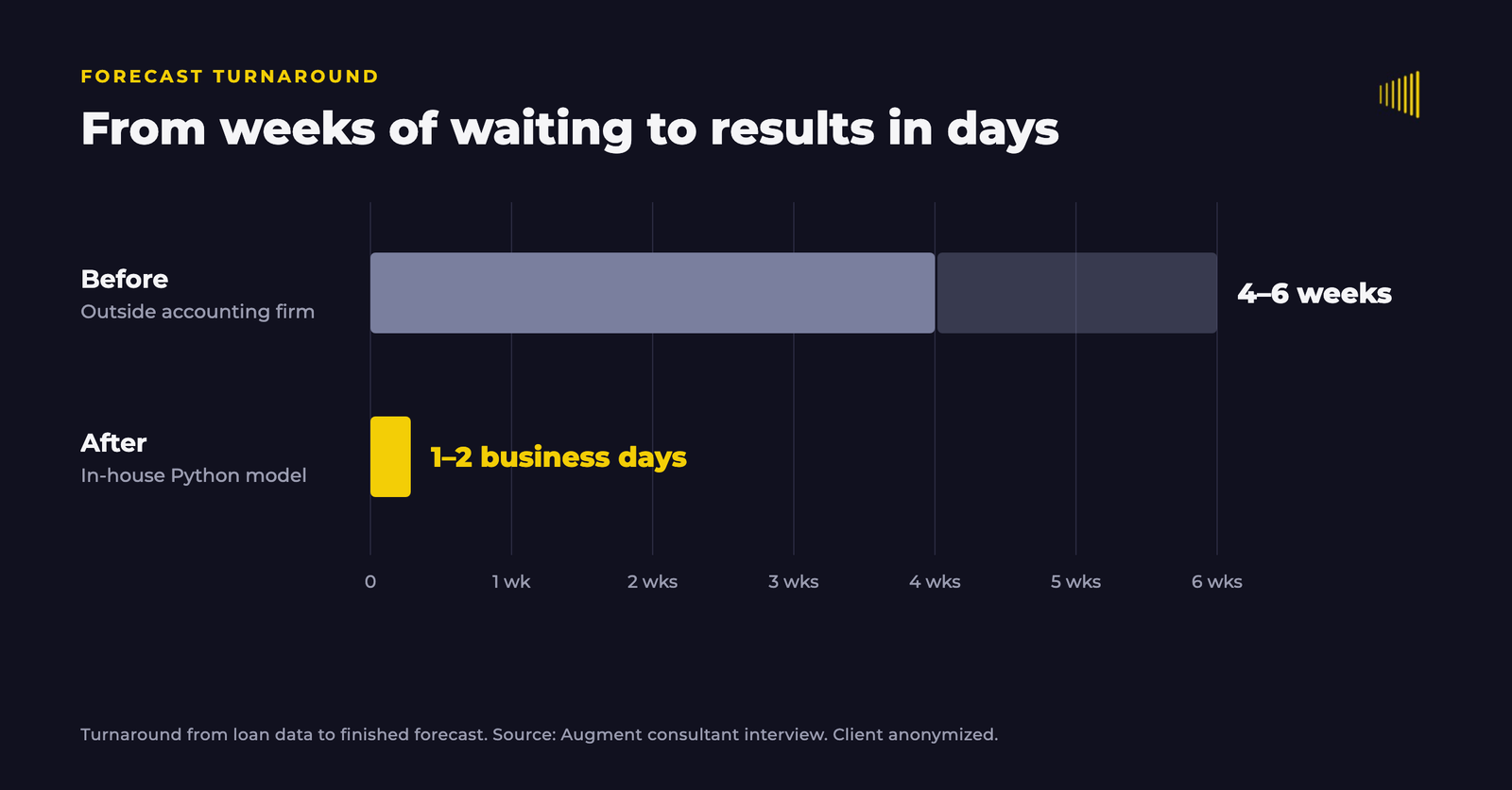
“We are running off of the actual end of quarter values, and that turnaround time is measured in terms of days.”
Augment FP&A consultant
The company no longer sends this work to the outside firm at all. The lending team now owns and runs its forecast.
The engagement grew over time. When the main client contact left the company, the consultant took on the regulatory filings and began working with accounting on expense documentation. According to the consultant, the client’s feedback was strong throughout, and every request was delivered on time. The client renewed the engagement twice, for six more months each time, which made three consecutive contracts over about 18 months.
The Lesson
Many finance teams send complex models to outside firms when they lack the staff to run them. The problems show up slowly. Forecasts arrive late and rest on estimates, and the team loses the ability to run its own numbers.
Here the results came from spending three months confirming every assumption with the team before automating anything, and from keeping the finished model and its documentation in the client’s own systems. The finance team now owns its forecast and runs it in days.
Does your forecast depend on an outside firm or on one person who knows how it works? Augment Analytics helps finance teams bring that work in-house and keep it there.