
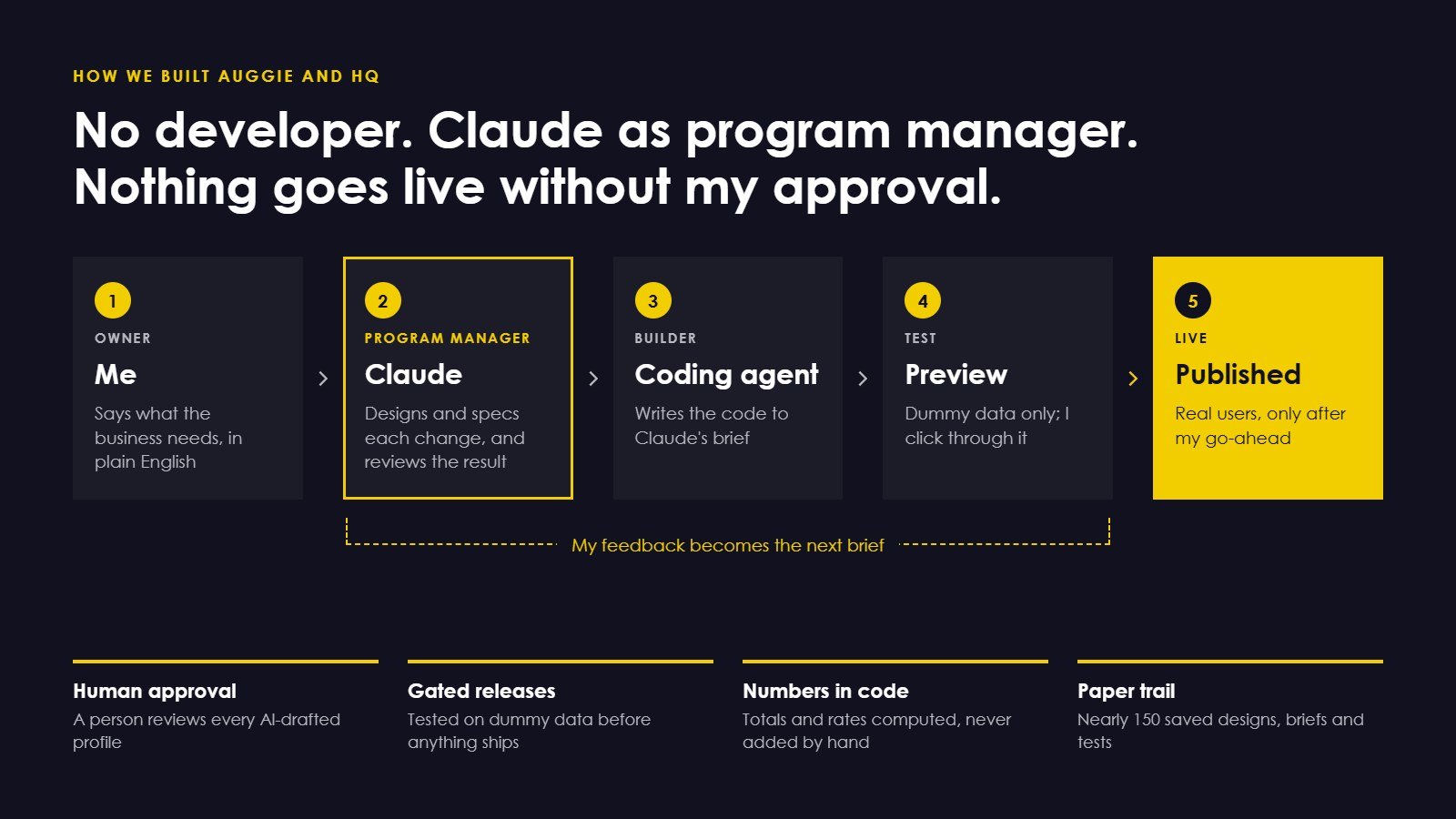
In September, I said I was building a consultant management system for Augment. It’s live, and it’s only one of several tools we’ve built. None of them was built by a developer. I built them with Claude as my program manager: Claude designs and specs each change, a coding agent writes it, I test it with dummy data, and nothing goes live without my approval. Here is what now runs Augment.
Auggie, our consultant platform
Many of our consultants are already using Auggie, and their feedback has already made the app better. Auggie lets consultants:
- Sign in without a password (Google, Microsoft, or an emailed code) and sign their NDA electronically.
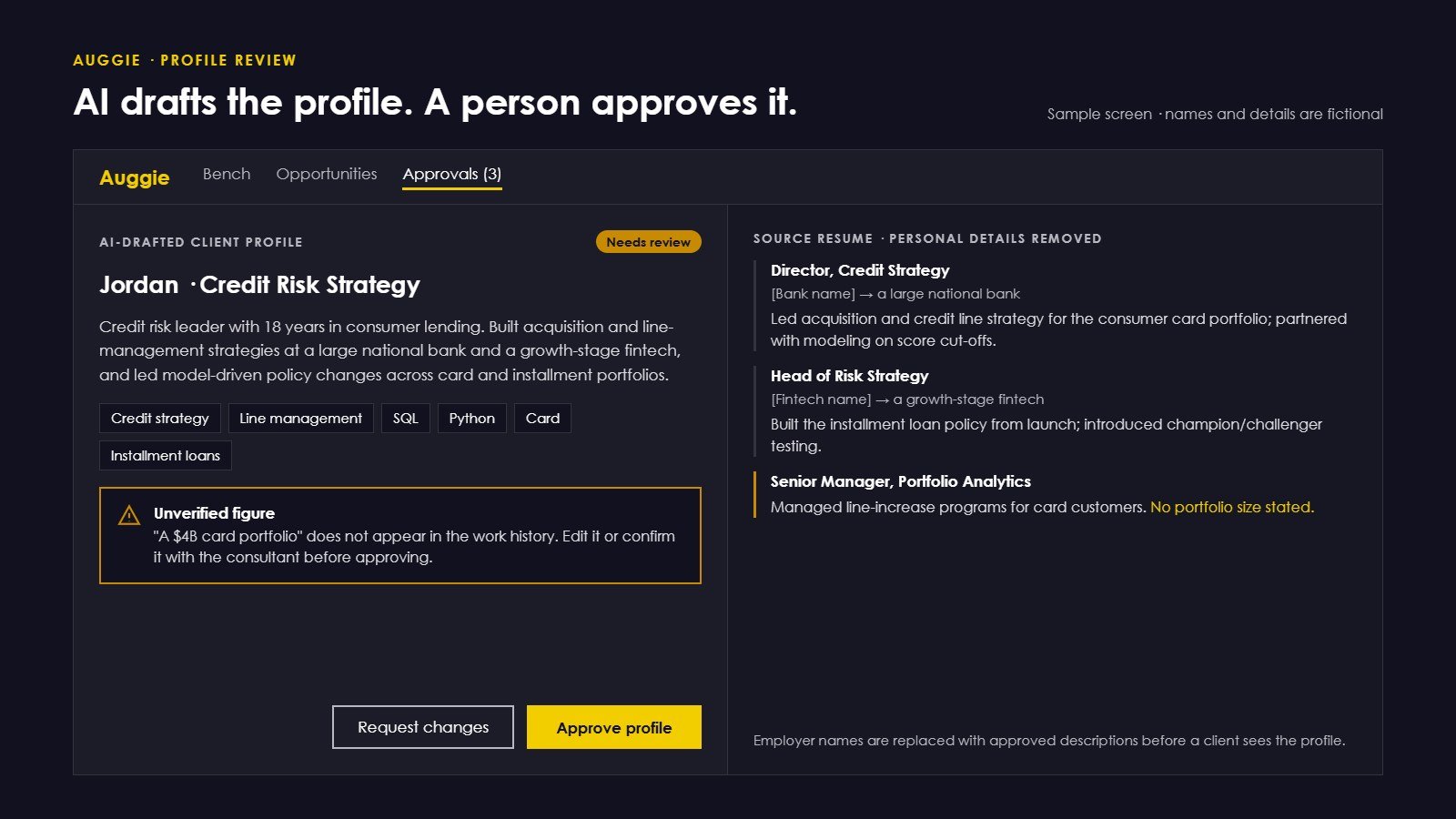
- Review a profile drafted with AI from their resume: work history, skills, industries, experience areas and a professional summary. Personal information is removed from resumes before they go to the AI model.
- Propose edits to their summary, add skills and experience areas, and upload a new resume (every 90 days).
- Update their contact details, availability and preferred hours.
- Choose whether their profile is included when prospective clients search.
Behind the scenes, Auggie also gives Vivek and me:
- A bench search across the whole platform.
- An approval queue so that a person reviews every AI-drafted profile before a client can see it.
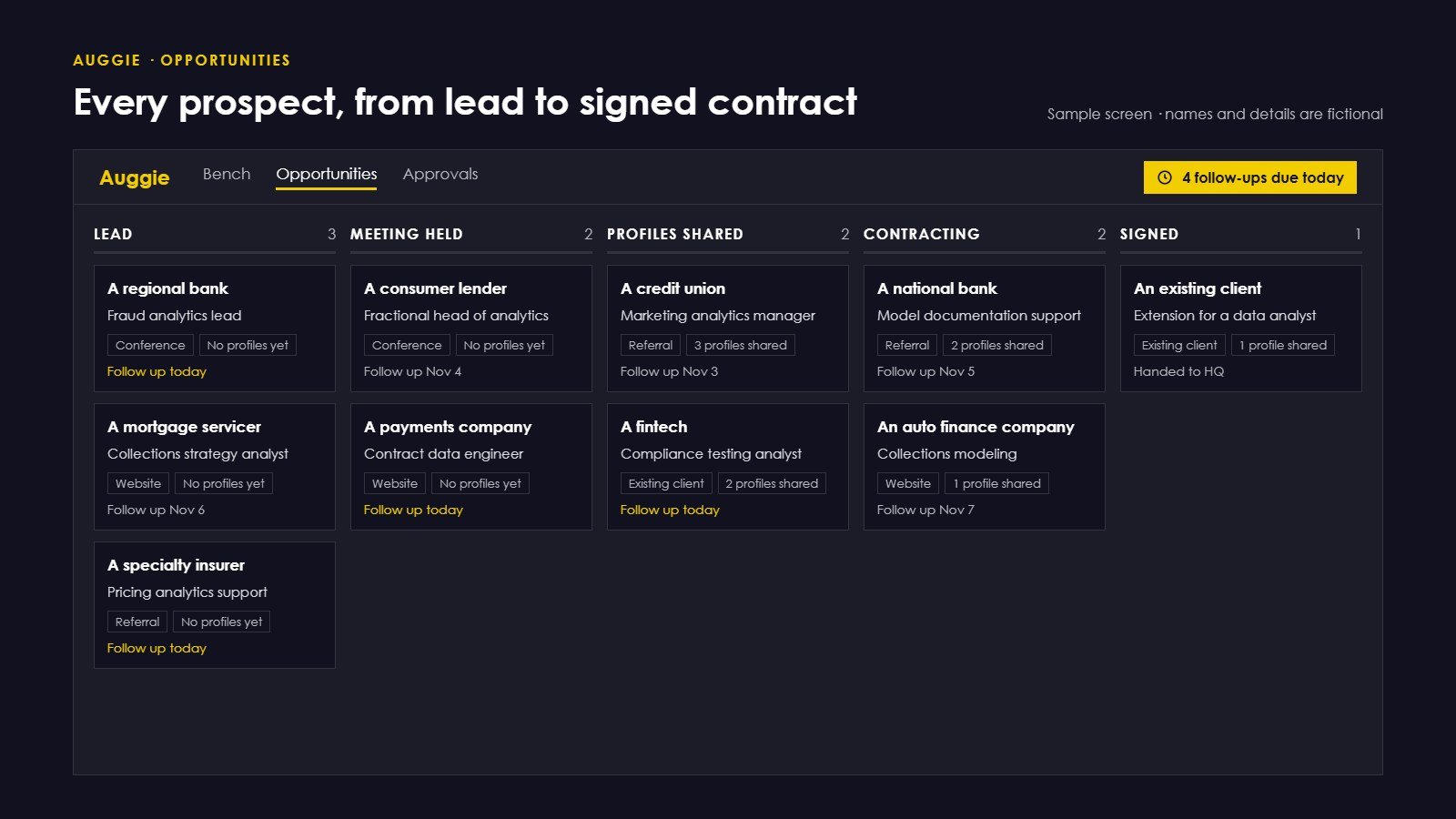
- An Opportunities pipeline. It tracks every prospect from lead to signed contract, along with which consultants’ profiles we’ve shared, and it brings each lead back up when its follow-up date arrives. This month we logged 45 leads from LEND360 in it.
When we needed compliance experts quickly last week, I found the right people and downloaded their profiles right out of Auggie.
What’s next for Auggie: consultants will be able to see when their profile has been shared with a prospective client (I’m aiming for this quarter), clients will be able to run AI-powered searches of available consultants, and consultants will eventually be able to see their engagement hours in Auggie.
HQ, our back office
HQ is Auggie’s sister app, and it runs the business side of Augment:
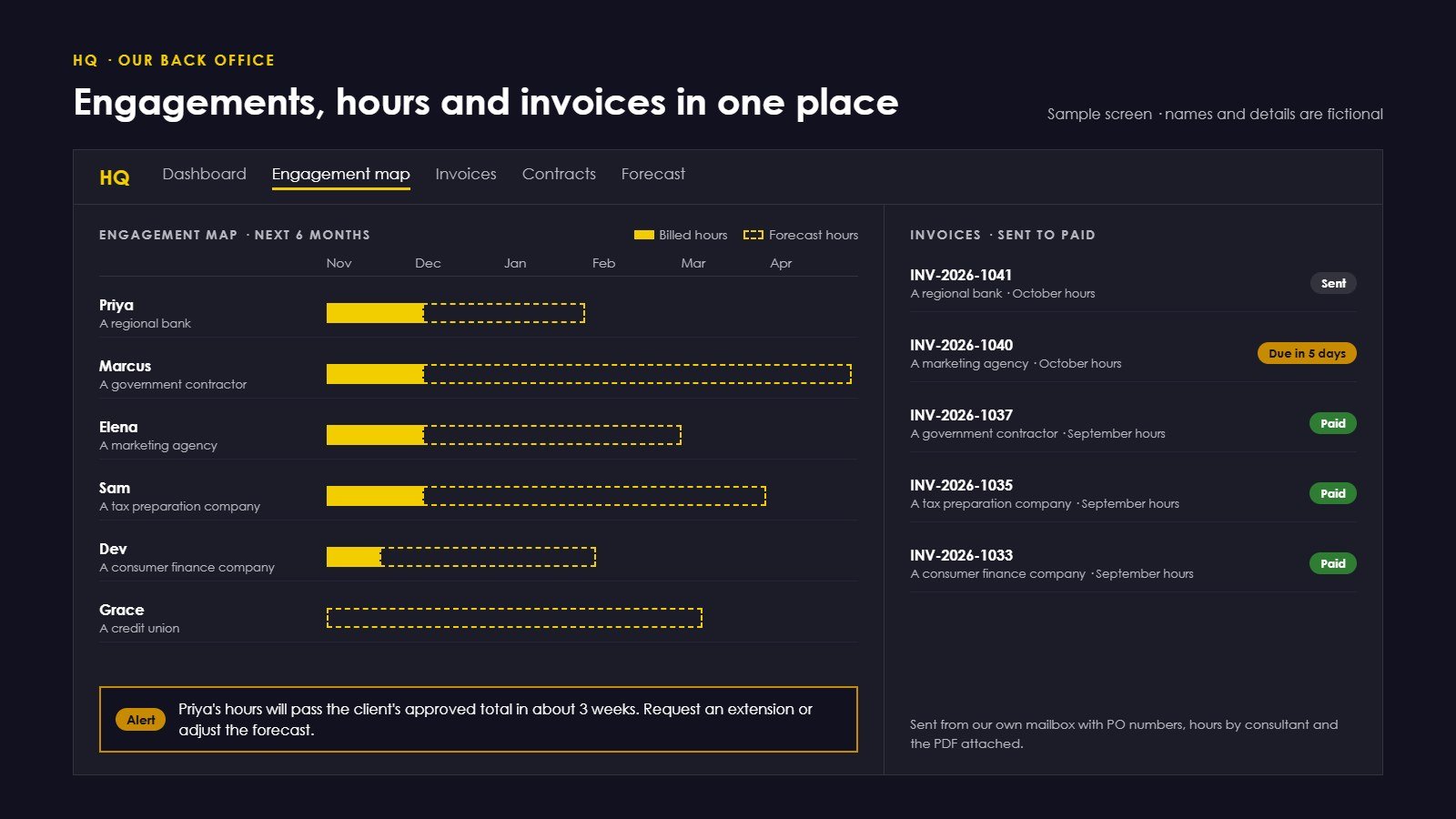
- Invoicing. HQ creates and sends invoices from our own Microsoft mailboxes, with the detail clients need (PO numbers, hours by consultant, the PDF), and tracks every invoice from sent to paid.
- Contracts and work orders. Every agreement, work order and extension is in one place, linked to the consultant and the client.
- Controls. HQ compares billed hours with forecast hours and sends an alert before a consultant’s hours exceed what a client has approved. A reconciliation ties invoices to payroll so that revenue and costs stay aligned.
- Forecasting. A revenue dashboard, an engagement map and a 12-month forecast now replace the spreadsheets I used to maintain by hand.
- HQ and Auggie sync every morning, so when an opportunity in Auggie becomes a signed client, HQ already knows about it.
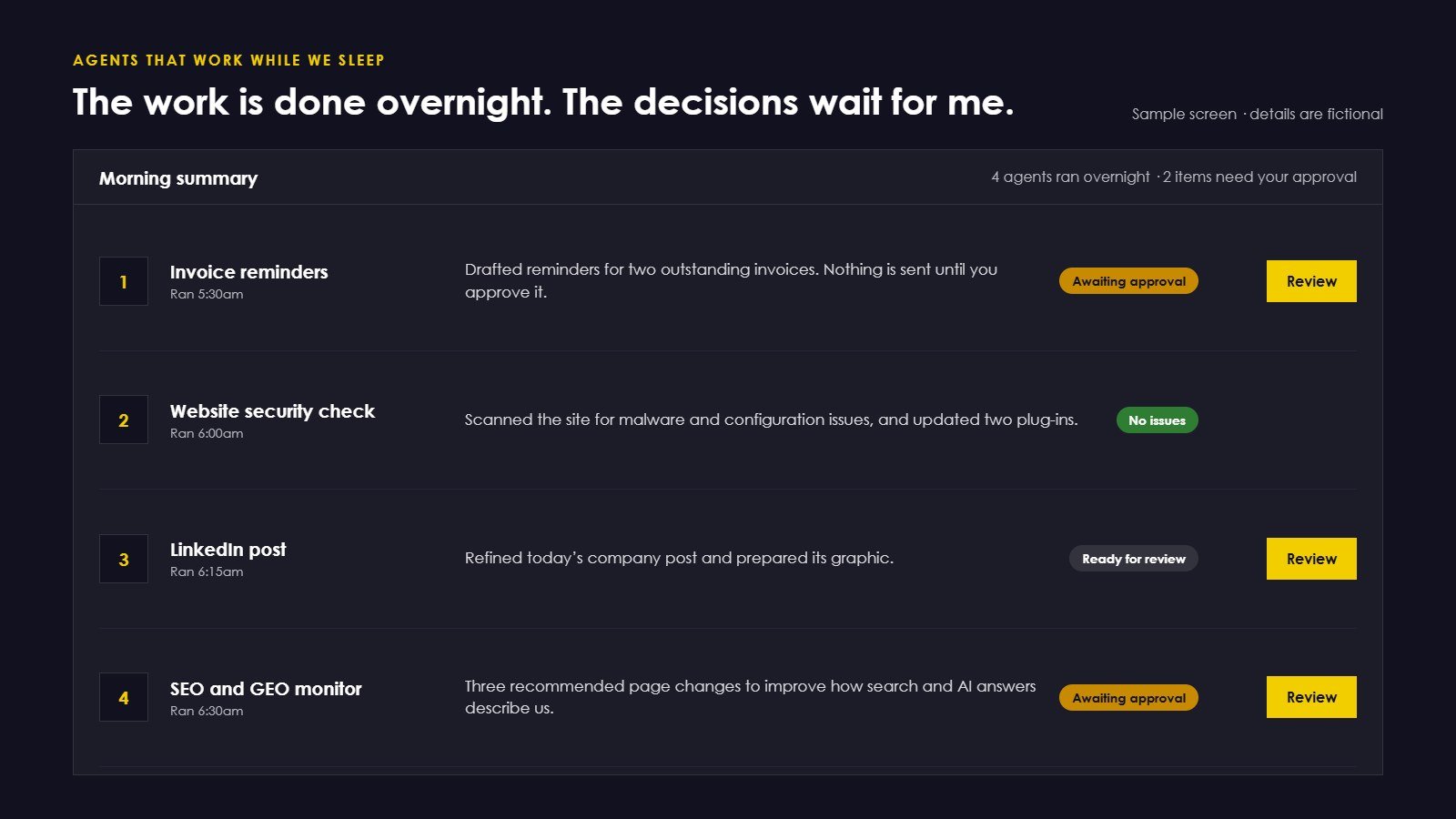
Agents that work while we sleep
- A scheduled agent prepares reminders for outstanding invoices and sends them after my explicit review and approval.
- Monitoring agents check the Augment website for malware and security configuration vulnerabilities and keep plug-ins up to date.
- A daily agent refines our LinkedIn posts and prepares a graphic for each, and Claude refines these updates and our client work into Insights posts and case studies on the website.
- An agent monitors Augment’s SEO/GEO performance and proactively recommends improvements (which it also implements with my approval) that drive organic traffic. In just two weeks since going live, it has brought us an auto finance lead as well as a data engineering inquiry from an insurance home services provider.
Auggie has taken me about 60 nights and weekends to build so far, including a 10-day vacation. HQ came together alongside it. Every design, brief and test lives in a paper trail of nearly 150 saved documents, and totals and rates are always computed in code rather than added by hand. All of this in just two months; imagine what we will be able to do over the next 12 months!
The tools also change our economics. Every hour I don’t spend on invoicing, reconciliations and spreadsheets, and every vendor tool HQ has replaced, is back-office time and expense we no longer carry. Those savings are what allow us to keep the margins on our staff augmentation as low as anyone’s.