
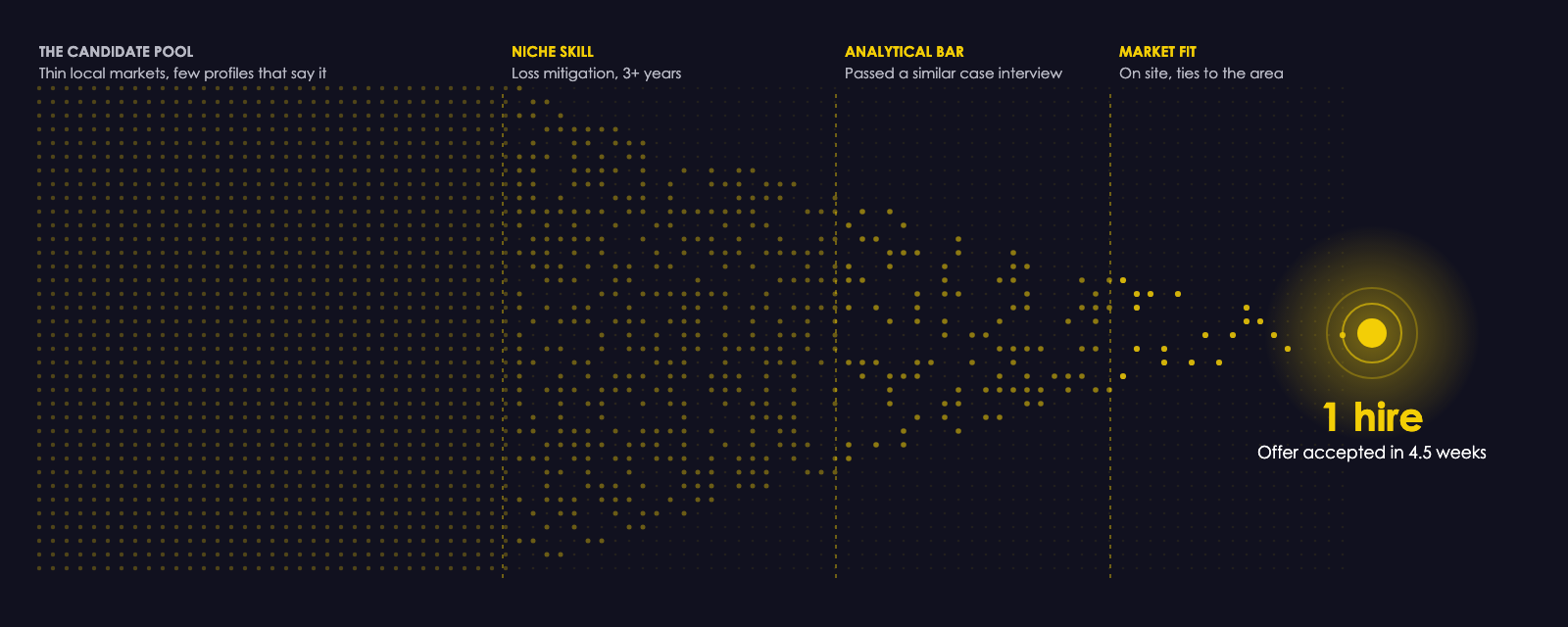
A consumer lender needed a loss mitigation analyst for a five-day, on-site role with no sponsorship. Augment’s recruiter had an offer accepted four and a half weeks after intake.
Each line on that brief shrank the pool. Loss mitigation, the part of risk management that works to reduce losses on loans that go bad, is a narrow specialty, and many of the people who do it never use the term on LinkedIn. A demanding case interview meant many people with the right experience still would not get through. Since COVID, plenty of analysts have moved to remote or hybrid jobs, and a five-day office role turns them away. No sponsorship further narrowed the field. Neither office market has the depth of D.C., New York, San Francisco or Chicago.
That is the kind of search a large company hands to an outside recruiter.
“They’re not giving you a role because it’s easy. … [It’s] because it’s hard to find.”
Augment recruiting consultant · 20+ years recruiting in financial services
One Rule, Set at Intake
Before sourcing a single name, the consultant and the hiring manager settled how they would treat a good candidate. No slate of ten, no waiting to compare.
“This is not a search where … you want to make sure you get a slate of … 10 candidates and you give them all [a] chance to go through the process and weigh them. No, when you find someone [who’s] really good, let’s move forward with them and give them a compelling offer.”
Augment recruiting consultant
In a thin market, every extra week of comparing is a week for the best candidate to accept somewhere else. The hiring manager agreed and kept to it.
Where the Recruiter Looked
Signature tactic
Market-Ties Sourcing
Don’t stop at people who live near the office. Search for everyone who once lived, worked or studied there. In a thin market, that is often where the hire is. In this search, it was.
Searching only for people near the two offices would have found almost nobody. So the consultant also searched for people who had once worked or studied in either market. People in the middle of a move, or hoping to get home, answer a good message. Three more sources sharpened the list.
Where the bar was already cleared. The hiring manager came from a large national bank with a case interview as hard as the client’s or harder. Anyone who had passed an interview like that was a good bet to pass this one, so the consultant went after analysts with experience at similar banks.
The words people actually use. Many analysts who do loss mitigation describe it some other way. The consultant built a full list of adjacent job titles, terms and skills, using an AI assistant to catch the ones a person might miss, and searched on all of them.
“Loss mitigation is not going to be a keyword on their profile … but they [may] very much be doing [it].”
Augment recruiting consultant
The hiring manager’s own examples. The hiring manager shared profiles of candidates the team had liked before Augment was involved, along with the backgrounds of people already on the team. The consultant sourced from the same employers.
Four and a Half Weeks
The market-ties search found the hire: an analyst at a large bank with a personal connection to the client’s home metro. A personal message from the consultant got a reply. The candidate was already planning to move back to the area, and the new job would end an otherwise long commute.
Then the hiring manager kept the rule. After the first screen, the case, leadership and behavioral interviews all ran within three to four days. The consultant kept status reports going but skipped standing meetings, which this hiring manager didn’t want. The offer was accepted four and a half weeks after intake, and the new analyst started about three weeks after that.
Intake → offer accepted · 4.5 weeks
Offer accepted → first day · about 3 weeks
The consultant checked in on the hire’s first day. The new analyst liked the role and the location and saw a real chance to do well.
Augment then ran its usual post-placement review, led by someone other than the recruiter so the feedback stays unbiased. The client’s recruiting team and the hiring manager were very positive, and in a follow-up with Augment’s co-founder, the client’s risk leadership said it wants to work with Augment again when the right role opens.
If You Have a Role Like This
Augment often works as the whole recruiting team for smaller firms. This search was the other kind of engagement: one hard role for a company that already has recruiters. A few things from it carry over.
- Agree on speed before the first resume. Decide at intake that a strong candidate moves straight through.
- Hand over the profiles you liked. Include people you interviewed and didn’t hire. They show a recruiter what you mean faster than a job description does.
- Look past current addresses. In a small market, the best candidate may live somewhere else and want to come back.
- Expect the skill to be hidden. Niche skills often sit under other job titles and words. Search the adjacent terms too.
Augment can take on the one role your recruiters haven’t been able to fill, or recruit as an extension of your firm when you don’t have the recruiting resources you need internally.
Hire Talent →Augment Analytics provides experienced analytics, risk and compliance talent. The client in this case study is kept anonymous.